A/C Compressor
A/C Compressor
Refer to the applicable warnings and cautions for this system before performing the following operation.
• The A/C compressor may be removed and repositioned without discharging the refrigerant system or disconnecting the refrigerant lines.
Removal
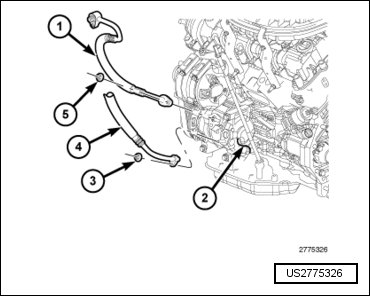
- Disconnect and isolate the negative battery cable.
- Recover the refrigerant from the refrigerant system. Refer to => [ Refrigerant System, Recovery ] Refrigerant System, Recovery.
- Raise and support the vehicle.
- Remove the splash shield from the right side frame rail..
- Remove the accessory drive belt.
- Remove the nuts (3 and 5) that secure the A/C discharge line (1) and the A/C suction line (4) to the A/C compressor (2).
- Disconnect the A/C discharge and suction lines from the A/C compressor and remove and discard the O-ring seals and gaskets.
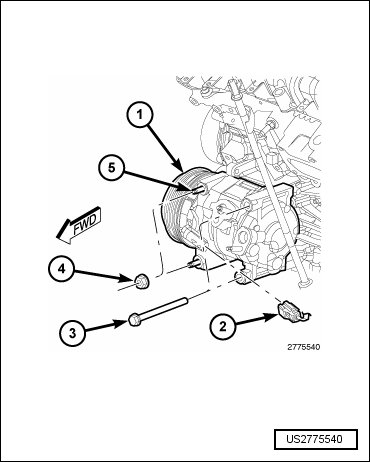
- Disconnect the wire harness connector (2) from the A/C compressor (1).
- Remove the two bolts (3) and two nuts (4) that secure the A/C compressor to the engine.
- If required, remove the two studs (5).
- Remove the A/C compressor from the engine compartment.
- Install plugs in, or tape over the opened refrigerant line fittings and compressor ports.
Installation
If the A/C compressor is being replaced, be certain to adjust the refrigerant system oil level. Refer to => [ A/C Compressor Refrigerant Oil Charge ] A/C Compressor Refrigerant Oil Charge
The A/C receiver/drier must be replaced if an internal failure of the A/C compressor has occurred. Failure to replace the A/C receiver/drier can cause serious damage to the replacement A/C compressor.
• When replacing multiple A/C system components, see the Refrigerant Oil Capacities chart to determine how much oil should be removed from the new A/C compressor. Refer to => [ A/C Compressor Refrigerant Oil Charge ] A/C Compressor Refrigerant Oil Charge.
• Replacement of the refrigerant line O-ring seals and gaskets is required anytime a refrigerant line is disconnected. Failure to replace the rubber O-ring seals and metal gaskets may result in a refrigerant system leak.
- If the A/C compressor (1) is being replaced, the refrigerant oil in the old compressor must be first drained and measured. Then the oil in the new A/C compressor must be drained. Finally, the new compressor must be refilled with the same amount of new refrigerant oil that was drained out of the old compressor. When replacing multiple A/C system components, see the Refrigerant Oil capacities chart to determine how much oil should be added to the refrigerant system. Refer to => [ A/C Compressor Refrigerant Oil Charge ] A/C Compressor Refrigerant Oil Charge.
- Position the A/C compressor to the engine.
- If removed, install the two studs (5). Tighten the studs securely.
- Install and tighten the two bolts (3) and two nuts (4) in the following sequence:
• Install bolts and hand tighten.
• Install nuts and hand tighten.
• Tighten upper nut to 40 Nm (30 ft. lbs.).
• Tighten lower nut to 40 Nm (30 ft. lbs.).
• Tighten upper bolt to 23 Nm (17 ft. lbs.).
• Tighten lower bolt to 23 Nm (17 ft. lbs.).
- Connect the wire harness connector (2) to the A/C compressor.
- Remove the tape or plugs from the opened refrigerant line fittings and the compressor ports.
- Lubricate new rubber O-ring seals with clean refrigerant oil and install them and new gaskets onto the refrigerant line fittings. Use only the specified O-rings as they are made of a special material for the R-134a system. Use only refrigerant oil of the type recommended for the A/C compressor in the vehicle.
- Install the A/C discharge line (1) and the A/C suction line (4) onto the A/C compressor (2).
- Install the nuts (3 and 5) that secure the A/C discharge and suction lines to the A/C compressor. Tighten the nuts to 23 Nm (17 ft. lbs.).
- Install the accessory drive belt.
- Install the splash shield onto the right side frame rail..
- Lower the vehicle.
- Connect the negative battery cable.
- Evacuate the refrigerant system. Refer to => [ Refrigerant System, Evacuate ] Refrigerant System, Evacuate.
- Charge the refrigerant system. Refer to => [ Refrigerant System, Charging ] Refrigerant System, Charging.