Transistorized Hall, Electronic Control Unit, Hall Sender & Knock Sensor
Transistorized Hall control unit, checkingTesting with transistorized ignition tester VW 1367
- carry out testing by following Test Equipment Operating Instructions provided with equipment
Testing with digital-multimeter US 1119
Requirement
Ignition coil OK
- remove connector from transistorized Hall control unit - to do this, press wire clip
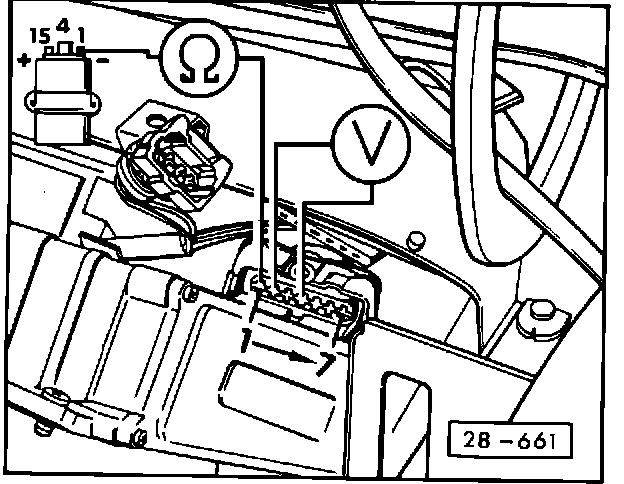
- connect multimeter US 1119 between contact 4 and 2 on connector
- switch ignition ON
^ specified value: approx. battery voltage
- switch ignition OFF
- check wire from terminal 1 on connector to terminal 1 of ignition coil for continuity
- re-connect transistorized Hall control unit connector
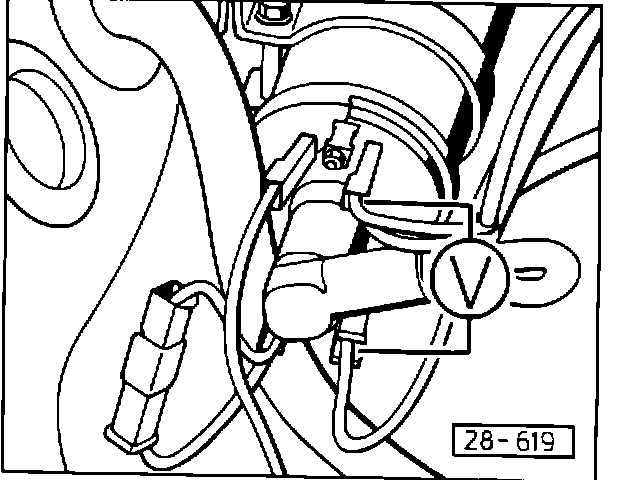
- connect multimeter US 1119 between terminal 1 (-) and terminal 15 (+) of ignition coil
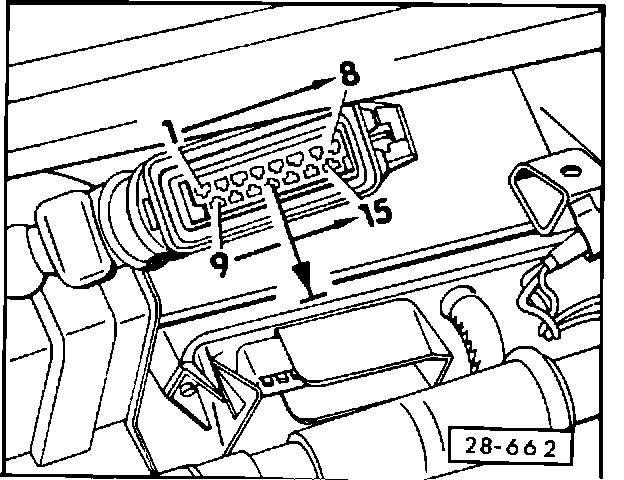
- unhook connector from electronic ignition control unit
Transistorized Hall control unit, continued
- switch ignition ON
^ specified value: min. 2 volts, after 1-2 seconds, must drop to 0
If NO
- replace transistorized Hall control unit
- inspect coil for fluid leakage
If YES
- replace ignition coil
- briefly touch terminal 12 of connector to ground
^ displayed voltage must briefly increase to minimum 2 volts
If NO
- replace transistorized Hall control unit
- switch ignition OFF
Electronic control unit, checking
Requirements
Ignition coil OK
Transistorized Hall control unit OK
- disconnect transistorized Hall control unit
- switch ignition ON
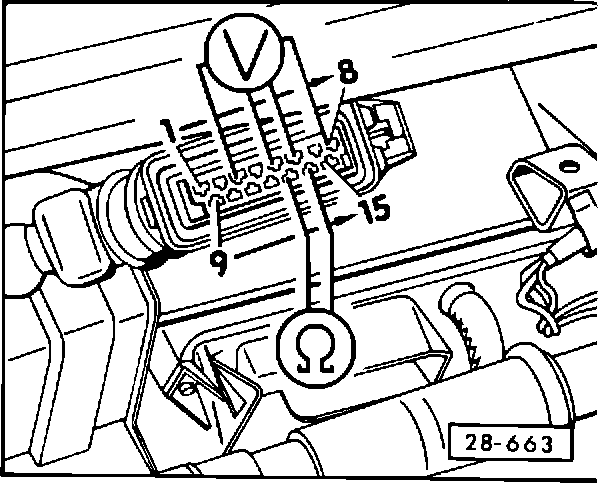
- measure voltage between terminals 3 and 5
^ specified value: approximately battery voltage measure voltage between terminals 6 and 3
^ specified value: approx. battery voltage
- open throttle valve
^ voltage must drop to 0 volts
If NO
- check throttle valve switch I (idle switch)
- measure voltage between terminals 8 and 3, while slowly opening throttle valve
^ approx. battery voltage
If NO
- Check throttle valve switch II (full throttle)
- switch ignition OFF
- measure resistance between terminals 13 and 14
Knock sensor type Specified value
I approx. 300 k Ohms
II approx. (infinite) Ohms
- re-connect electronic ignition control unit
Electronic control unit, checking continued
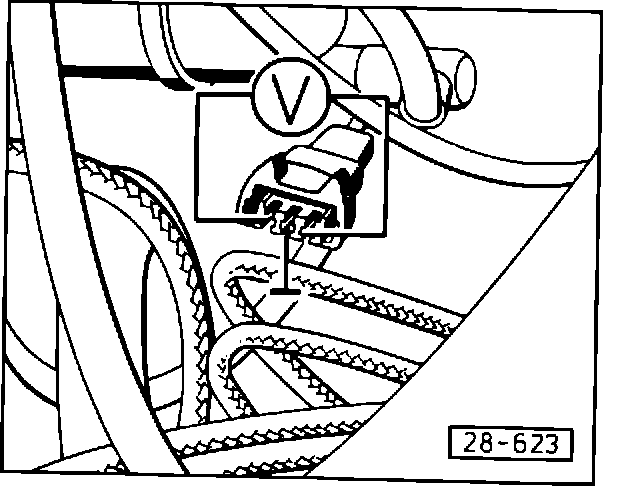
- remove connector from Hall sender (distributor) by pressing wire clip
- connect multimeter US 1119 to outer terminals of connector from Hall sender (distributor)
- switch ignition ON
^ specified value: minimum 5 volts
- switch ignition OFF
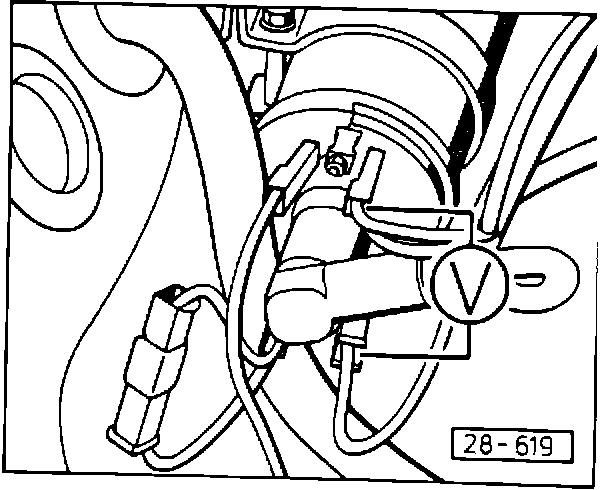
- connect multimeter US 1119 between terminal 1 (-) and terminal 15 (+) of ignition coil
- switch ignition ON
- touch center terminal of connector from Hall sender (distributor) briefly to ground
^ voltage value must increase briefly to minimum 2 volts
If NO
- replace electronic control unit
Hall sender, checking
Requirement
Electronic ignition control unit OK
- remove connector from transistorized Hall control unit by pressing on wire clip
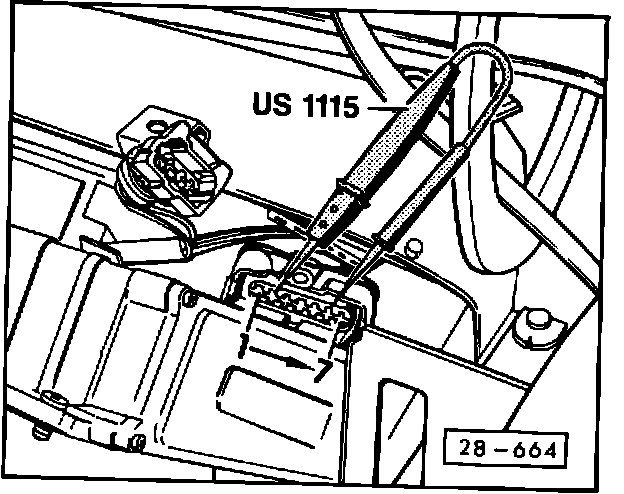
- connect voltage tester US 1115 to terminals 2 and 6 on connector
- operate starter
^ LED on US 1115 must flicker
If NO
- replace Hall sending unit
CAUTION
Do not use a "standard" test lamp having an electric bulb. The high electrical consumption of these test lamps can lead to damage of the electrical components.
Knock sensor, control unit vacuum sensor and vacuum hose, checking
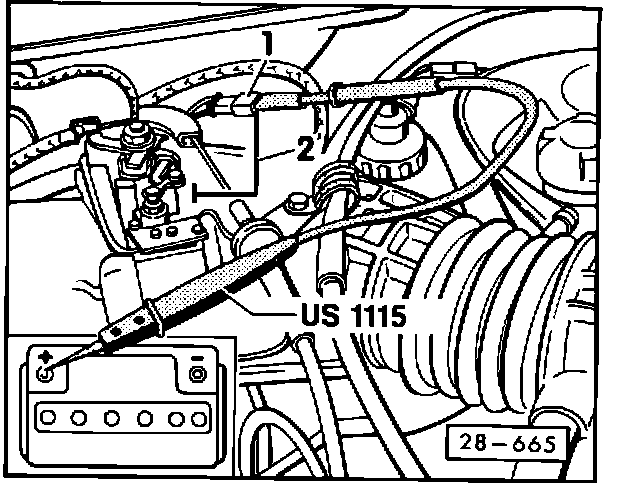
- connect voltage tester US 1115 to test connector 1 (single connector with blue/brown lead) and battery positive (+)
^ LED must light up
CAUTION
Do not use a "standard" test lamp having an electric bulb. The high electrical consumption of these test lamps can lead to damage of the electrical components.
- start engine
^ LED must go out (slight glowing is normal)
- increase rpm to over 3000 rpm one time
- If the LED lights up again, proceed as follows:
- connect jumper wire 2 to connector 1 and hold to ground (-) at least 3 seconds
Note
After that, the steady light of the LED must begin blinking. Observe the following patterns:
Blinking TWICE in intervals means:
^ Fault in knock sensor: Incorrect tightening torque, break in wiring or knock sensor is defective or
^ Electronic ignition control unit defective
Blinking THREE times in intervals means:
^ Break in vacuum hose to electronic ignition control unit or
^ Electronic ignition control unit (vacuum sensor) defective