Exhaust Gas Recirculation: Testing and Inspection
INSPECTION
1. INSPECT EGR SYSTEM
(a) Inspect and clean the filter in the EGR vacuum modulator.
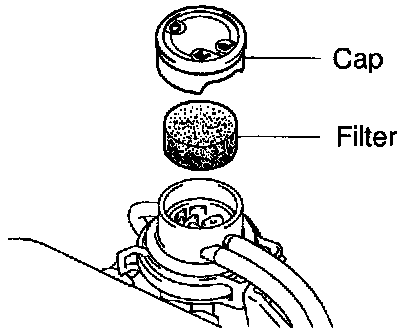
(1) Remove the cap and filter.
(2) Check the filter for contamination or damage.
(3) Using compressed air, clean the filter.
(4) Reinstall the filter and cap.
HINT: Install the filter with the coarser surface facing the atmospheric side (outward).
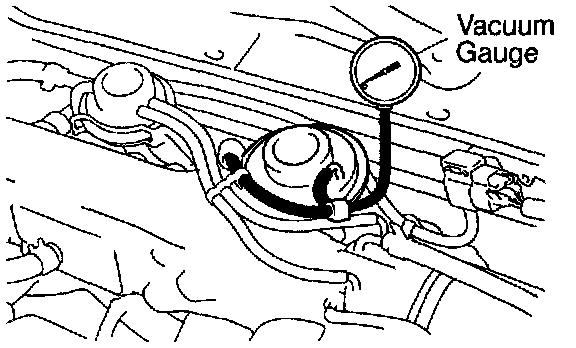
(b) Using a 3-way connector, connect a vacuum gauge to the hose between the EGR valve and [1][2][3]VSV.
(c) Inspect seating of the EGR valve.
Start the engine and check that the engine starts and runs at idle.
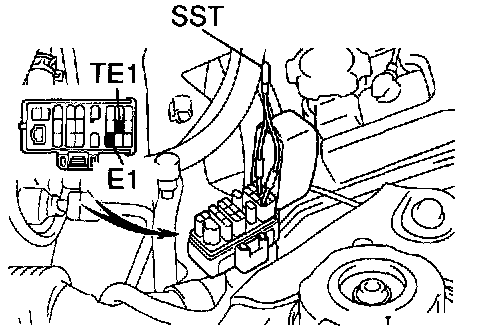
(d) Using SST, connect terminals TE1 and E1 of the DLC1. SST 09843-18020
(e) Inspect the [1][2][3]VSV operation with the cold engine.
(1) The engine coolant temperature should be below 55°C (131°F).
(2) Check that the vacuum gauge indicates zero at 2,500 rpm.
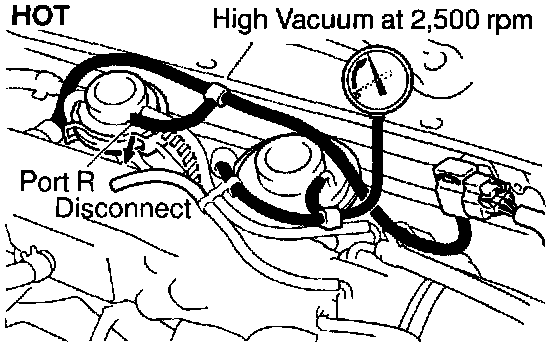
(f) Inspect the operation of the [1][2][3]VSV and EGR vacuum modulator with the hot engine.
(1) Warm up the engine to above 60°C (140°F).
(2) Check that the vacuum gauge indicates low vacuum at 2,500 rpm.
(3) Disconnect the vacuum hose port R of the EGR vacuum modulator and connect port R directly to the intake manifold with another hose.
(4) Check that the vacuum gauge indicates high vacuum at 2,500 rpm.
HINT: As a large amount of exhaust gas enters, the engine will misfire slightly.
(g) Remove the vacuum gauge and reconnect the vacuum hoses to the proper locations.
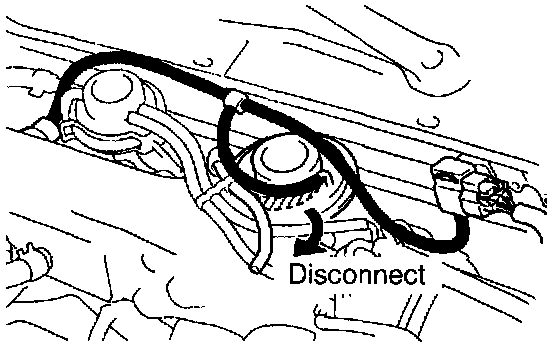
(h) Inspect the EGR valve.
(1) Apply vacuum directly to the EGR valve with the engine idling.
(2) Check that the engine runs rough or dies.
(3) Reconnect the vacuum hoses to the proper locations.
HINT: As exhaust gas is increasingly recirculated, the engine will start to misfire.
(i) Remove the SST from the DLC1. SST 09843-18020