Function of ECM
FUNCTION OF ENGINE CONTROL MODULE (ECM)ECM Transmission Control Connections:
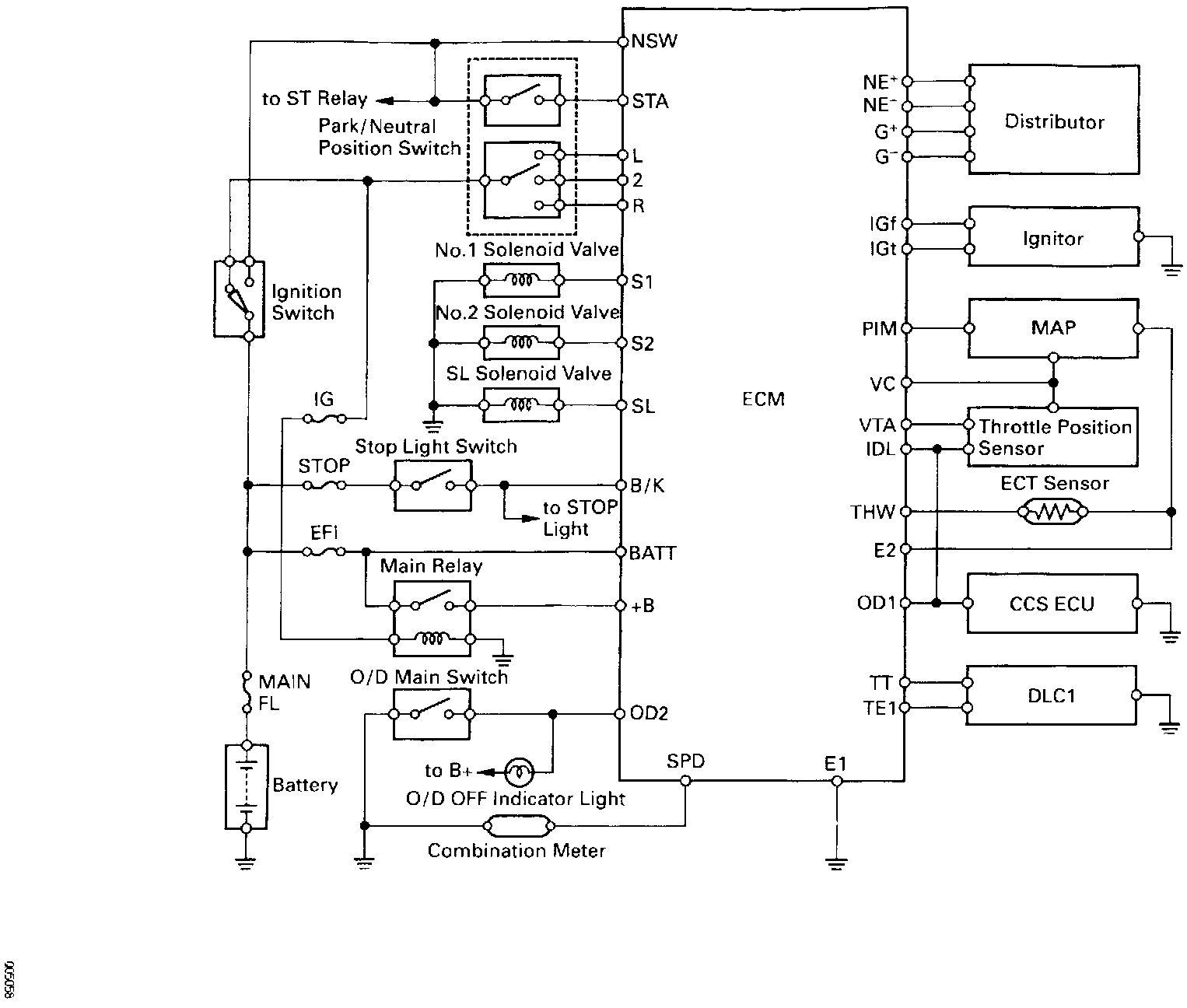
^ Control of Shift Timing
The ECM has programmed into its memory the optimum shift pattern for each shift lever position (D, 2, L position).
Based on the appropriate shift pattern. the ECM turns No.1 and No. 2 solenoid valves ON or OFF in accordance with the vehicle speed signal from the vehicle speed sensor and the throttle opening signal from the throttle position sensor. In this manner, the ECM operates each shift valve, opening or closing the fluid passages to the clutches and brakes to permit up-shifting or down-shifting of the transaxle.
HINT: The electronic control system provides shift timing and lock-up control only while the vehicle is traveling forward. In REVERSE, PARK and NEUTRAL, the transaxle is mechanically, not electronically controlled.
^ Control of Overdrive
Driving in overdrive is possible if the O/D main switch is ON and the shift lever is in the D position. However, when the vehicle is being driven using the cruise control system (CCS), if the actual vehicle speed drops to about 10 km/h (6 mph) below the set speed while the vehicle is running in overdrive, the CCS ECU sends a signal to the ECM to release the overdrive and prevent the transaxle from shifting back into overdrive until the actual vehicle speed reaches the speed set in the CCS memory.
On this model, if the coolant temperature falls below 55°C (131°F), the ECM prevents the transaxle from up-shifting into overdrive.
^ Control of Lock-up System
The ECM has programmed in its memory a lock-up clutch operation pattern. Based on this lock-up pattern, the ECM turns lock-up solenoid valve ON or OFF in accordance with the vehicle speed signals received from the vehicle speed sensor and the throttle opening signals from the throttle position sensor.
Depending on whether lock-up solenoid valve is ON or OFF, the lock-up relay valve performs changeover of the fluid passages for the converter pressure acting on the torque converter clutch to engage or disengage the lock-up clutch.
Mandatory Cancellation of Lock-up System:
If any of the following conditions exist, the ECM turns OFF lock-up solenoid valve to disengage the lock-up clutch.
(1) The brake light switch comes on during braking.
(2) The coolant temperature falls below 55°C (131°F).
The purpose of (1) is to prevent the engine from stalling if the front wheel lock up. The purpose of (2) is improve general driveability. and to speed up engine warm-up.
Also. while the lock-up system is in operation, the ECM will temporarily turn it OFF during upshift or down-shift in order to decrease shifting shock.