Evaporative Emissions System: Description and Operation
The evaporative control system prevents gasoline vapors from escaping into the atmosphere. Vapors from the gas tank are routed to the evaporative control canister. Carbon in the canister stores the gasoline vapors until the engine is started. The intake manifold vacuum of the running engine draws the vapors trough the two diaphragm valves into the combustion chamber, where the vapors are burned.
Evaporative Control System:
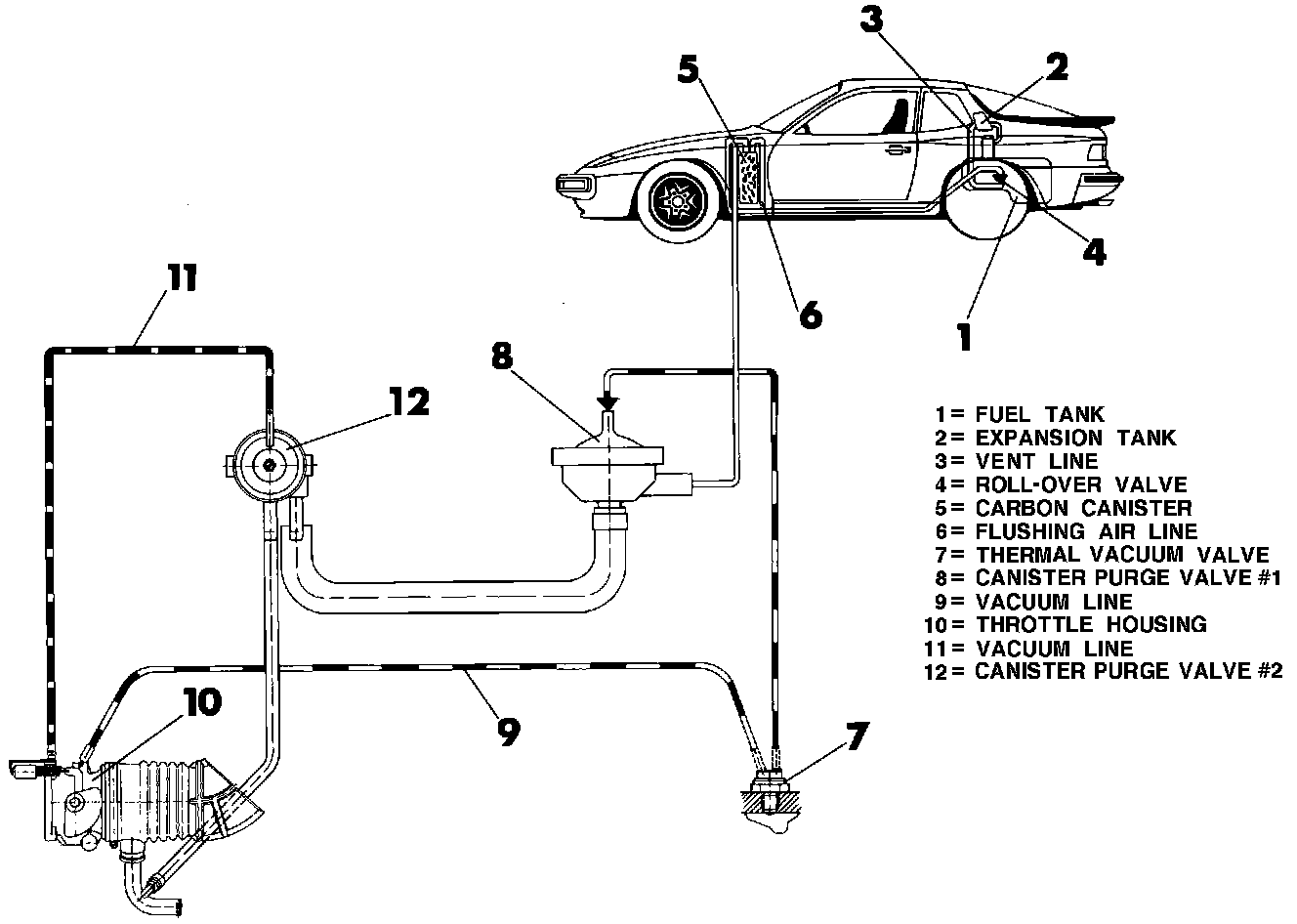
The evaporative control system consists of an expansion tank, roll-over valve, carbon canister, thermostat valve, diaphragm valve #1, diaphragm valve #2, connecting hoses and the fuel filler cap, Fig. 36.
When the engine is off, the fuel vapors collect in the carbon canister where they are absorbed by the carbon.
When the engine is running, the fuel vapors must be removed from the tank and carbon canister. This is done by opening the connection between the carbon canister and the intake manifold, so the vapors can be drawn into the combustion chamber.
Diaphragm valve #1 can only operate when the thermostat valve opens the vacuum hose connection to the throttle housing. The thermostat valve opens when the engine temperature has reached 58° C (136° F). When throttle housing vacuum is applied to diaphragm valve #1, the connection between the carbon canister and diaphragm valve #2 opens.
Diaphragm valve #2 opens when throttle housing vacuum is applied (usually under normal and high engine loads). This opens the connection between diaphragm valve #1 and the intake manifold. When both diaphragm valve #1 and #2 are open, the fuel vapors are drawn through the intake manifold to the combustion chamber where they get ignited and burned.
COMPONENTS:
EXPANSION TANK
The expansion tank is used as a gas overflow canister.
When the gas tank is full and the outside temperature changes from cold to hot (or other influencing factors), the fuel expands into the expansion tank. As the fuel level drops, the gas flows back into the tank via a hose connection.
ROLL-OVER VALVE
A roll-over valve is installed between the expansion tank and the carbon canister. It operates through mechanical motion.
The valve is a safety devise that stops liquid fuel from leaking into the carbon canister when the vehicle is at an angle. At a specific angle, for example, roll-over of vehicle, accident, parked on steep hill etc, the valve closes and the liquid fuel can not exit the tank system.
CARBON CANISTER
The canister contains carbon (activated charcoal) which absorbs the gasoline vapors from the fuel tank. The suction created by the intake air system draws the fuel vapors from the carbon out of the canister. The use of alcohol-gasoline fuels will reduce the effectiveness of the carbon in the canister.
THERMOSTAT VALVE
When the engine has reached a temperature of 58° C (136° F), it opens the vacuum connection from the intake manifold to diaphragm valve #1.
DIAPHRAGM VALVE #1
This valve is controlled by the thermostat valve and the throttle housing vacuum. A vacuum line is routed from diaphragm valve #1 through the thermostat valve to the throttle housing. When the thermostat valve is open and no vacuum is applied to the diaphragm valve, the vapor hose connections are blocked off. With vacuum at the diaphragm valve, the connection is opened and the fuel vapors can pass through it.
DIAPHRAGM VALVE #2
This valve is controlled by a vacuum line routed to the throttle housing. When vacuum is applied to diaphragm valve #2, the vapor hose connections are blocked off. With vacuum at the diaphragm valve, the connection is opened and the fuel vapors can pass through it.
FUEL FILLER CAP
The filler cap is a non vented type to keep the fuel vapors in the gas tank system. Never replace non vented type filler cap with vented type cap.