Fluid Pressure Inspection
Fluid Pressure Inspection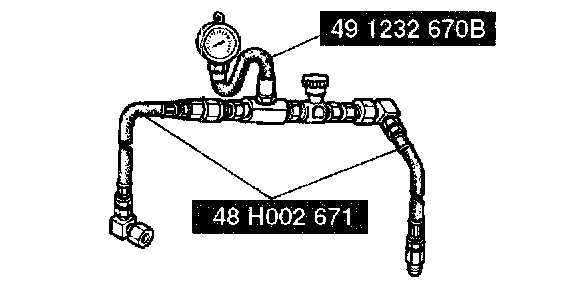
1. Assemble the SSTs as shown in the figure.
Tightening torque 30 - 39 Nm (3.0 - 4.0 kg-m, 22 - 28 ft. lbs.)
2. Mark both hose connections to ensure that the hose is reinstalled in its original position.
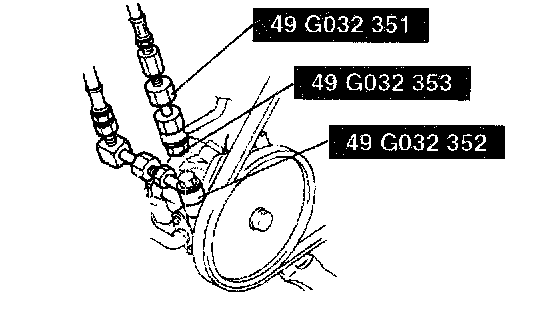
3. Disconnect the pressure hose from the oil pump, and connect the SSTs (adapters).
4. Connect the SSTs (gauge set) to the SSTs (adapters).
5. Bleed the air from the system.
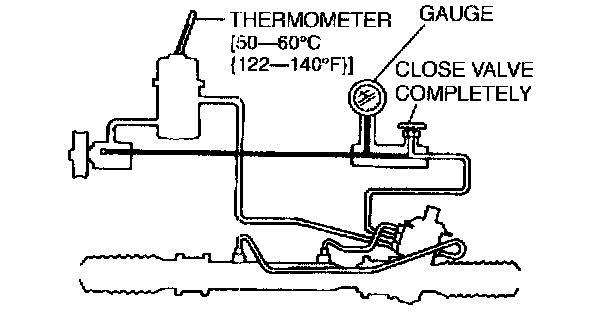
6. Open the gauge valve fully. Start the engine and turn the steering wheel fully left and right to raise the fluid temperature to 50 - 60°C (123 - 140°F).
7. Close the gauge valve completely. Increase the engine speed to 1,000 - 1,500 rpm and measure the fluid pressure generated by the oil pump.
^ If the pressure is not within the specification, replace the oil pump component.
Oil pump fluid pressure 8,340 - 8,830 kPa (85.0 - 90.0 kg./cm2, 1,210 - 1,280 psi)
Caution:
^ If the valve is left closed for more than 5 seconds, the fluid temperature will rise excessively and adversely affect the oil pump.
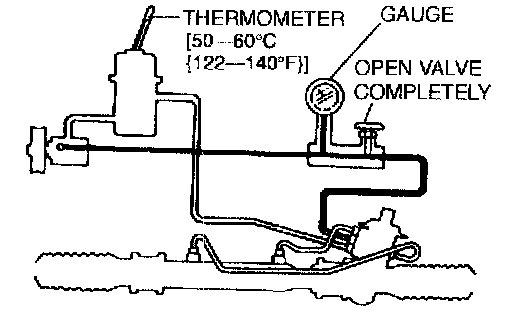
8. Open the gauge valve fully and increase the engine speed to 1,000 - 1,500 rpm.
9. Turn the steering wheel fully to the left and right, then measure the fluid pressure generated at the gear housing.
^ If the pressure is not within the specification, repair or replace the steering gear component.
Gear housing fluid pressure 8,340 - 8,830 kPa (85.0 - 90.0 kg./cm2, 1,210 - 1,280 psi)
Caution:
^ If the steering wheel is kept in the fully turned position for more than 5 seconds, the fluid temperature will rise excessively and adversely affect the oil pump.
10. Remove the gauge set. Install and tighten the pressure hose to the specified torque.
Tightening torque 30 - 44 Nm (3.0 - 4.5 kg-m, 22 - 32 ft. lbs.)
11. Bleed the air from the system.