System Inspection
1. Remove the ECM.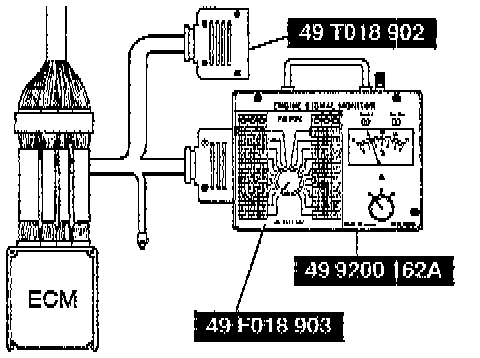
2. Connect the SSTs to the ECM.
3. Warm up the engine to normal operating temperature and let it idle.
4. With no electrical load operating check the torque reduction inhibit signal at the ECM terminal 4R by using an oscilloscope.
5. If the torque reduction inhibit signal can not be detected, carry out inspection following symptom troubleshooting.
^ P0100 (Mass air flow circuit malfunction)
^ P0110 (Intake air temperature circuit malfunction)
^ PO115 (Engine coolant temperature circuit malfunction)
^ PO12O (Throttle position circuit malfunction)
^ PO130, PO134, PO14O, PO1SO, PO154, PO16O (02 sensor circuit malfunction/no activity detected)
^ P0335 (Crankshaft position sensor circuit malfunction)
^ P1792 (Barometric absolute pressure sensor)
6. Lift up the vehicle.
7. Shift the selector lever to D.
8. Depress the accelerator pedal, and verify that the engine speed does not exceed 1,500 rpm.
9. If the engine speed smoothly increase over 1,500 rpm, check the torque reduction request signal at the ECM terminal 45 by using an oscilloscope.
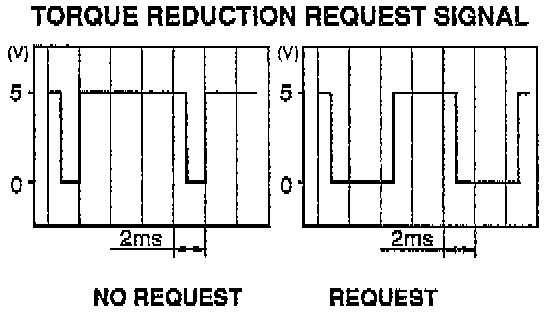
10. Depress the accelerator pedal, and verify that the signal changes as shown in the figure.
11. If there is no change, check the ABS/TCS control unit.
12. Let the engine idle.
13. Check the torque reduction inhibit signal of the ECM terminal 4R by using an oscilloscope.
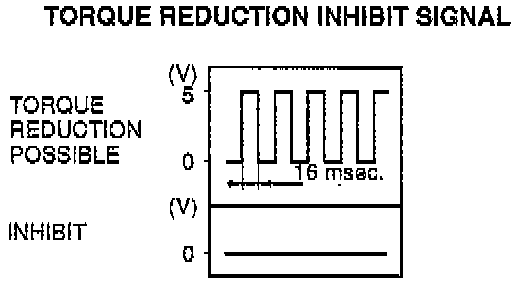
14. Disconnect the engine coolant temperature sensor connector, and verify that the signal voltage is 0V.
15. If not as specified, check the ECM terminal 3G (Engine coolant temperature sensor) voltage.