Air Injection Control Valve: Description and Operation
Air Injection System:
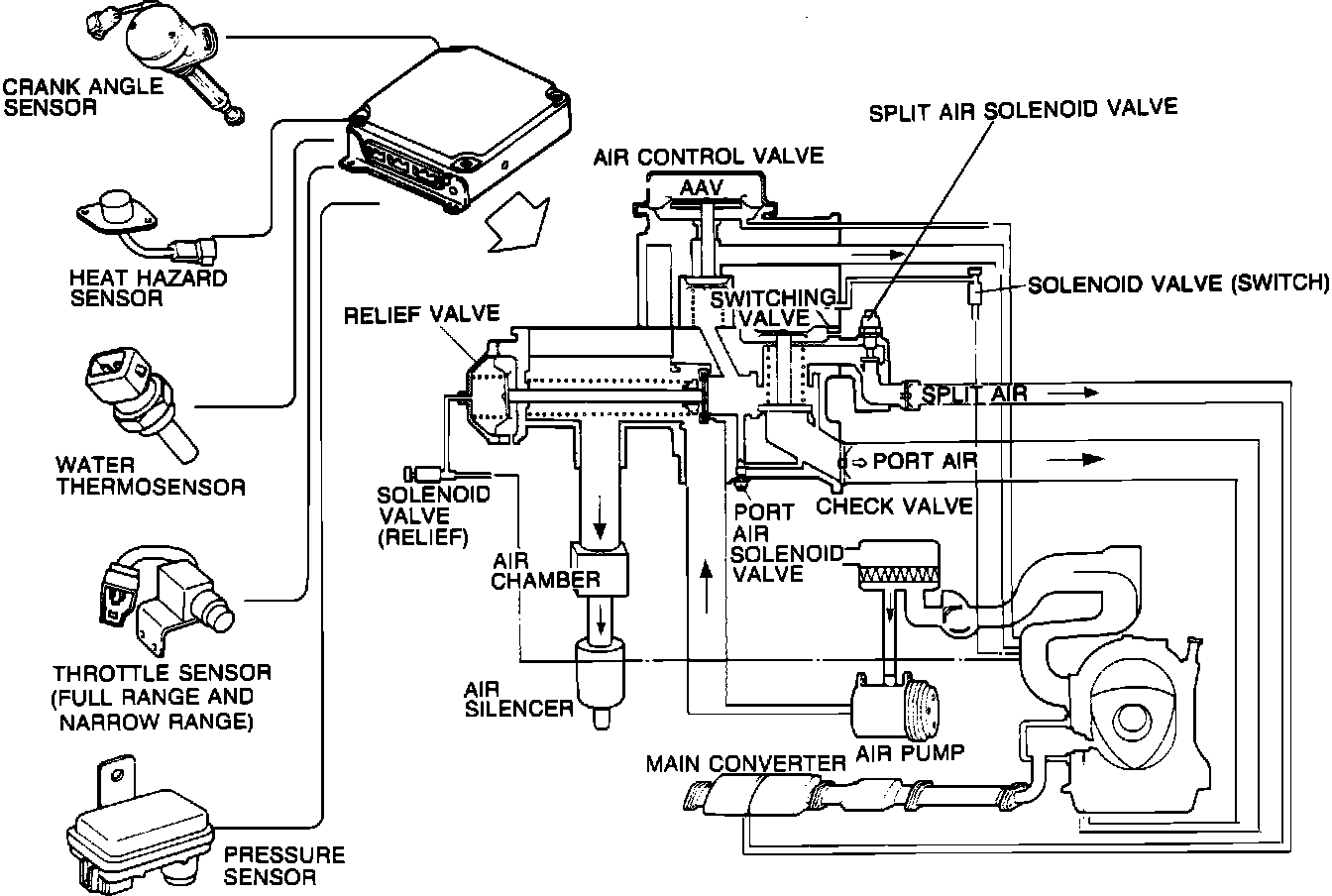
SYSTEM OPERATION
The system is designed to reduce hydrocarbon (HC) and carbon monoxide (CO) emissions by supplying filtered air into the exhaust ports. When this air meets the hot exhaust gases exiting the combustion chambers, combustion continues, further oxidizing the HC and CO in the exhaust. These pollutants are then converted into carbon dioxide and water vapor. After cold start-up, and during periods of engine warm-up the additional heat energy released helps to bring the catalyst up to operating temperature more quickly. When the car is being driven in high gear (5th gear), the air control valve directs some of the air downstream of the exhaust manifold, to the catalytic converter to promote oxidation in the converter. The system consists of an air pump, check valves, air control valve, anti-afterburn valve, solenoid switching valve, solenoid relief valve, heat hazard sensor.
AIR PUMP
The air pump is a belt driven pump that is used to supply air to the air injection system.
CHECK VALVE
There are two check valves located in the air injection system. One is located in the air line going to the exhaust ports and the other is located in the air line going to the catalytic converter. The check valves allow air from the air pump to be delivered to their respective destinations while preventing the exhaust gases from backfeeding through the system and damaging components.
AIR CONTROL VALVE
The air control valve directs air to either the exhaust port, main converter, or the relief air silencer.
ANTI-AFTERBURN VALVE
The anti-afterburn valve is a vacuum operated valve that supplies fresh air to the rear port during deceleration.
SOLENOID SWITCHING VALVE
The solenoid switching valve controls the operation of the switching valve section of the air control valve.
SOLENOID RELIEF VALVE
The solenoid relief valve controls the operation of the relief valve section of the air control valve.
HEAT HAZARD SENSOR
The heat hazard sensor monitors the floor temperature and sends a signal to the control unit. If the heat sensor is turned on, then the air being delivered to the catalytic converter is turned off.
SPLIT AIR SOLENOID VALVE
The split air solenoid valve is a part of the air control valve. It controls the amount of air that is allowed to flow to the catalytic converter.
PORT AIR SOLENOID VALVE
The port air solenoid valve diverts a measured quantity of air to the exhaust manifold under certain conditions.