Communication Network
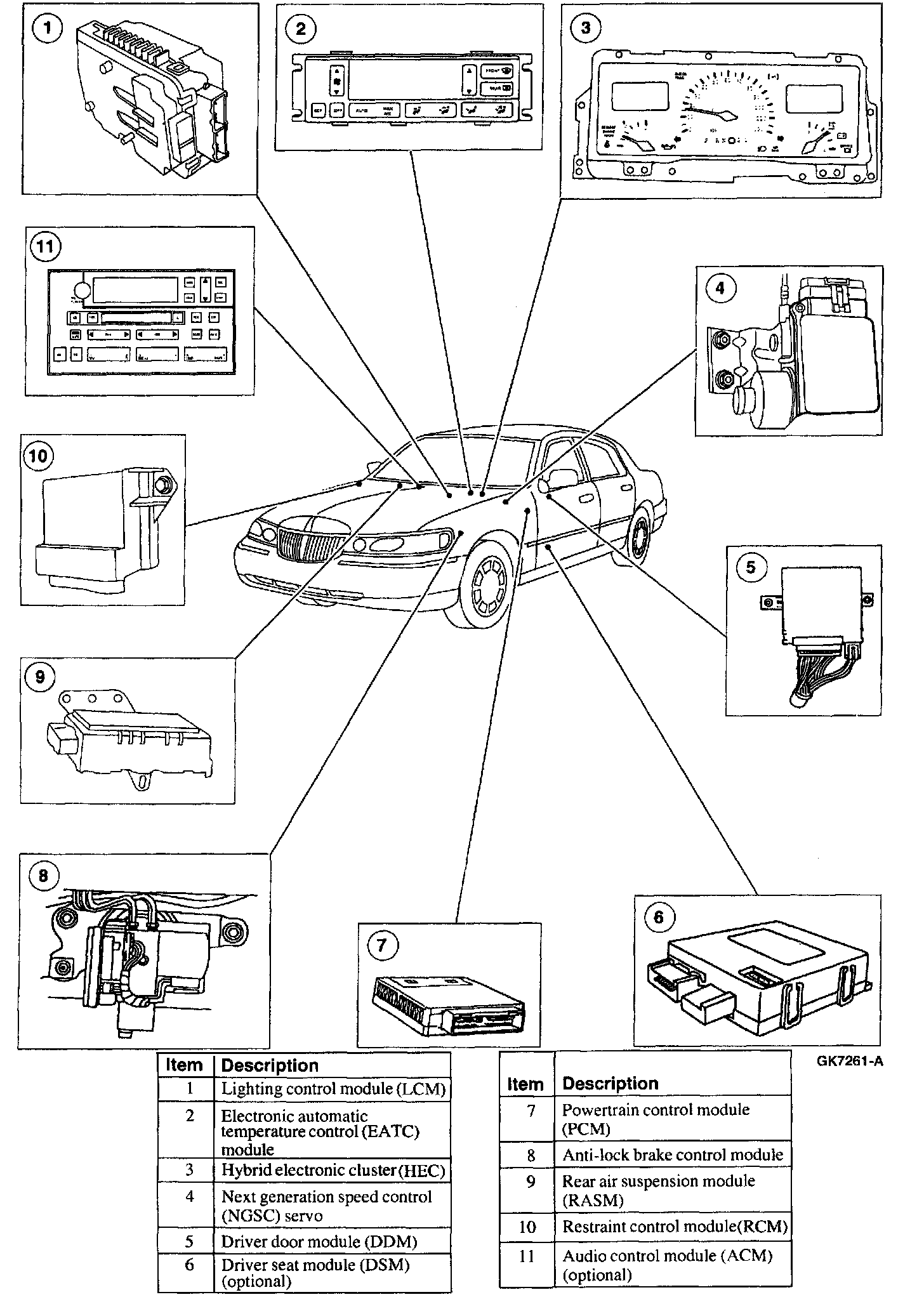
The vehicle has two module communication networks. The Standard Corporate Protocol (SCP), which is an unshielded twisted-pair cable (data bus plus, Circuit 914 [TN/OG] and data bus minus, Circuit 915 [PK/LB]) and the International Standards Organization (ISO)9141 communications network, which is a single-wire network (Circuit 70 [LB/WH]). Both networks can be connected to New Generation STAR (NGS) Tester by one connector called the Data Link Connector (DLC). This makes diagnosis and testing of these systems easier by allowing one smart tester to be able to diagnose and control any module on the two networks from one connector. The DLC can be found under the instrument panel, between the steering column and the radio.
The ISO 9141 communication network does not permit inter module communication. When the NGS Tester communicates to modules on the ISO 9141 communication network, the NGS Tester must ask for all information; the modules cannot initiate communications.
The SCP communication network will remain operational even with the severing of one of the bus wires. Communications will also continue if one of the bus wires is shorted to ground or battery positive voltage (B+), or if some, but not all, termination resistors are lost.
Unlike the SCP communication network, the ISO 9141 communication network will not function if the wire is shorted to ground or battery positive voltage (B+). Also, if one of the modules on the ISO 9141 communication network loses power or shorts internally, communications to that module will fail.
The RASM is connected to the SCP communication network. The RASM controls the vehicle's air ride suspension and the variable assist steering function.
The anti-lock brake control module is connected to the SCP communication network. The module controls the brake pressure to the four wheels to keep the vehicle under control while braking.
The ACM is connected to the SCP communication network and also to the Audio Control Protocol II (ACP II) communication network. The ACM communicates with the compact disc and the cellular phone transceiver.
The DDM is connected to the SCP communication network. The module controls many functions including power windows, power locks and keyless remote entry. The DDM also communicates with the Driver Seat Module (DSM) to control power seat and mirror memory.
The DSM is connected to the SCP communication network. The DSM controls the driver power seat. The module also communicates with the DDM to control the driver seat memory and both outside memory mirror functions.
The EATC module is connected to the SCP communication network. The EATC module controls automatic climate functions that maintain the vehicle at a constant temperature setting.
The RCM is connected to the ISO 9141 communication network. The RCM controls the deployment of the air bags based on sensor input.
The HEC is connected to the SCP communication network. The HEC displays information received on the SCP including speedometer, odometer, fuel and message center warnings. The HEC also controls the Passive Anti-theft System (PATS).
The LCM is connected to the SCP communication network. The LCM controls both interior and exterior lighting, anti-theft functions and warning chimes.
The NGSC servo is connected to the SCP communication network. The servo, when activated, controls and maintains vehicle speed by actuating the throttle linkage.
The PCM is connected to the SCP communication network. The PCM controls the engine performance, electronic ignition, emission controls and on-board diagnostics.