Removal and Installation
REMOVAL1. Raise vehicle on hoist.
2. Remove wheel and tire assembly from rotor mounting face. Use care to avoid damage to or interference with wheel cylinder bleeder screw during removal.
3. Mark front disc brake caliper assembly to make sure it is installed on correct side during installation.
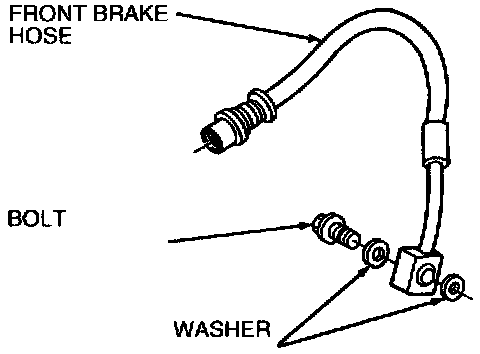
4. Disconnect front brake hose from front disc brake caliper. Remove hollow retaining bolt that connects front brake hose fitting to front disc brake caliper. Remove hose assembly from front disc brake caliper and plug front brake hose.
5. Remove lower disc brake caliper locating pin.
6. Rotate front disc brake caliper approximately 90 degrees away from front disc brake caliper anchor plate.
7. Slide front disc brake caliper away from front disc brake caliper anchor plate until front disc brake caliper disengages from upper disc brake caliper locating pin
INSTALLATION
1. Install replacement front disc brake caliper by engaging upper disc brake caliper locating pin into insulator.
2. Rotate front disc brake caliper assembly in place on front disc brake caliper anchor plate.
3. Install lower disc brake caliper locating pin. Tighten to 88 Nm (65 ft. lbs.).
NOTE: A new disc brake caliper locating pin is recommended due to the thread locking compound on threads.
4. Remove plug and install front brake hose on front disc brake caliper with new copper washers on each side of fitting outlet. Insert new retaining bolt through washers and fittings. Tighten bolts to 40 Nm (30 ft. lbs.).
5. Bleed serviced component. Always replace rubber bleed screw cap after bleeding.
6. Install wheel and tire assembly using Rotunda Accutorq Lug Nut Sockets 164-RO303 or equivalent on 1/2 inch drive air impact wrench. A torque wrench may be used. Tighten lug nuts to 115-142 Nm (85-104 ft. lbs.).
CAUTION: Failure to tighten lug nuts in a star pattern may result in high rotor runout, which will speed up the development of brake roughness, shudder and vibration.
7. Lower vehicle.
8. Road test vehicle.