Electronic Brake Control Module: Description and Operation
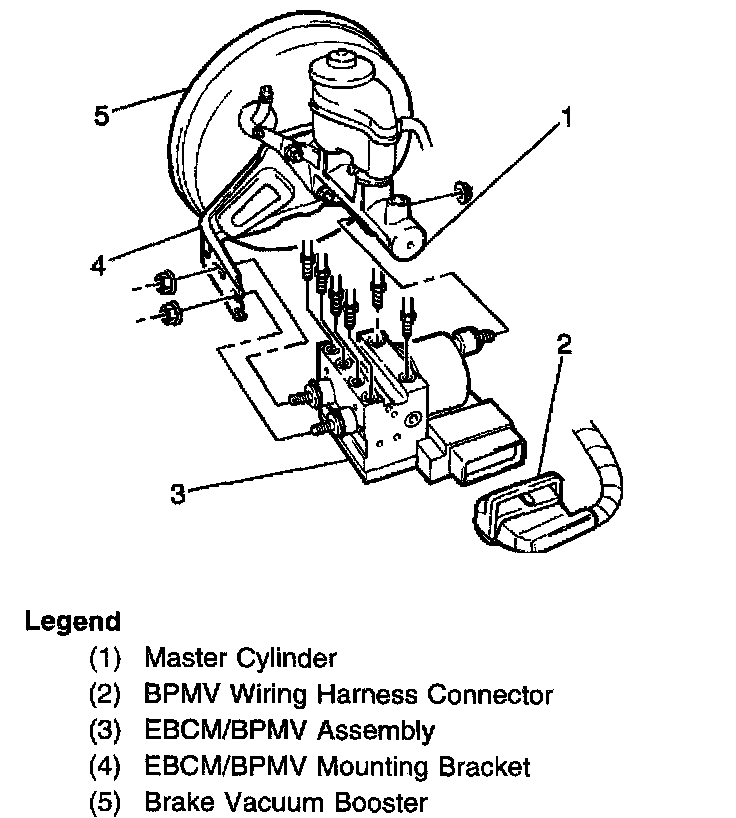
Electronic Brake Control Module (EBCM)/Brake Pressure Modulator Valve (BPMV)
The BPMV assembly is a compact integrated unit that contains the following components:
^ An EBCM
^ Four solenoid valves (one for each wheel brake hydraulic channel)
^ Four flow control valves in-series with each wheel brake hydraulic channel (one for each solenoid valve)
^ Buffer chambers
^ A pump motor
^ Check valves The BPMV assembly is located on the left rear corner of the engine compartment just below the master cylinder. The BPMV assembly is mounted on a bracket. The controlling element of the ABS is a microprocessor based EBCM. The inputs to the system include the following components:
^ The four wheel speed sensors
^ The stoplamp switch
^ The ignition switch
^ The battery voltage
^ The OBD2 Data Link Connector (DLC)
The outputs include the following components:
^ The four solenoid valves
^ The pump motor
^ The ABS indicator
^ The DLC The EBCM monitors the speed of each wheel. If any wheel begins to slip during braking, the EBCM actuates the solenoid valves and the pump motor to modulate hydraulic pressure to the wheel brake(s) approaching slip. Once the wheel regains traction the hydraulic pressure is increased until the wheel again begins to slip. This cycle repeats until any of the following happens:
^ The vehicle comes to a stop.
^ The brake pedal is released.
^ No wheels approach slippage. Additionally the EBCM monitors each input and each output for proper operation. The EBCM sets a Diagnostic Trouble Code (DTC) when it detects a system malfunction. The DTC will not clear when the battery is disconnected because the EBCM stores DTCs in nonvolatile memory. The EBCM is an integral part of the BPMV assembly and is not serviceable separately.