Antilock Brakes / Traction Control Systems: Description and Operation
Fig. 2 Bosch ABS/ASR Brake System:
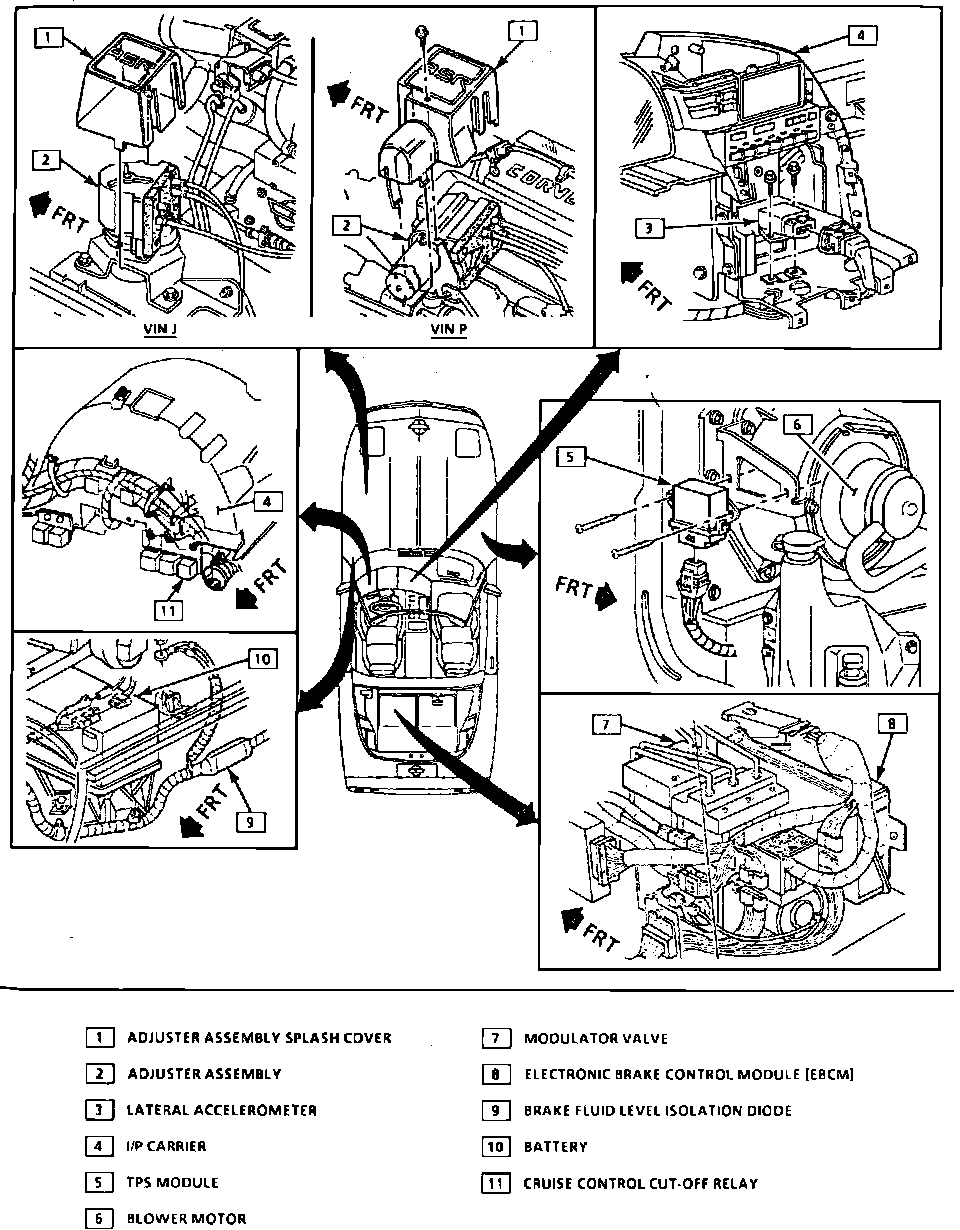
The anti-lock brake system (ABS) with an integrated acceleration slip regulation (ASR) system, Fig. 2, maintains vehicle maneuverability under severe braking conditions on most road surfaces. The ABS/ASR systems monitors each wheel speed during braking. The Electronic Brake Control Module (EBCM) uses this information to produce signals to prevent the braking wheels from locking.
The ASR traction system uses engine spark retard, throttle close down and rear brake intervention to provide better acceleration and vehicle stability. The ASR system can function up to maximum vehicle speed. The system enhances the directional control, traction and maneuverability. The ASR system uses input information from wheel speed, vehicle speed, to allow traction priority to low speeds and directional control at high speeds, vehicle acceleration and throttle position, during low vehicle acceleration the controls are more sensitive and brake application input.
The ABS/ASR common components are four wheel speed sensors and sensor rings, master cylinder reservoir which supplies the ABS/ASR modulator valve, the EBCM and wire harness. The ABS/ASR components that are specific to the ASR system are the adjuster assembly - throttle and cruise control cables, prime pipe from master cylinder to modulator valve, ASR Off switch, spark retard table added to the ECM, throttle position sensor (TPS) module, cruise control cutoff relay, ASR lamps and lateral accelerometer.
OPERATION
When ignition switch is turned to On position, amber ANTI-LOCK warning lamp in the instrument panel illuminates. When engine is started, it goes out. If ABS warning light does not go out or comes on permanently while driving, it indicates a fault in ABS system.
When starting vehicle, the control module performs a functional check of electrical circuitry. The test cycle checks components of the monitoring circuit as well as the logic section. Test sample signals are sent to the control module, which checks whether or not the correct output signals are available.
Since the ABS system may not be used every day, there is an additional test which actually runs the modulator valve. Whenever ignition switch is turned to On position and vehicle reaches 4 mph, the test starts. Operation of the modular valve can be heard and felt, if the driver's foot is on the brake pedal. This test is performed once, each time the vehicle is started.
This system continuously monitors the following components: modulator valve, control module, lateral acceleration switch, wheel speed sensors, wiring harness and relays.
The control module constantly monitors its own supply voltage. If supply voltage drops below a predetermined value, ABS will be switched Off and the amber ANTI-LOCK lamp will come on. When supplied voltage returns to or exceeds the predetermined value, ANTI-LOCK lamp will go off. If a fault occurs in ABS, the ANTI-LOCK warning lamp comes on and ABS will be switched off. The system will remain off until vehicle is restarted at which time the functional check is repeated.