Combination Valves, Checking
Diagnostic Procedures
Combination Valves, Checking
Test Conditions
• Vacuum lines and hose connections free of leaks.
• Vacuum hoses not clogged or kinked
• Pressure hose between combination valves and pressure hose for Secondary Air Injection (AIR) Pump Motors not clogged or kinked.
• Ignition switched off.
Test Sequence
Special tools, testers and auxiliary items required
• Hand vacuum pump (V.A.G 1390)
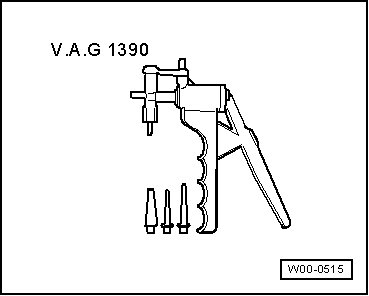
- Disconnect corresponding vacuum line of combination valve to be checked:
• Cylinder bank 1 combi-valve.
• Cylinder bank 2 combi-valve.
• Cylinder bank 1 with cylinders 1 through 6 is located at right in direction of travel.
• Cylinder bank 2 with cylinders 7 through 12 is located at left in direction of travel.
- Connect hand vacuum pump to corresponding vacuum connection of combination valve.
- Disconnect corresponding pressure hose from combination valve to be checked on Secondary Air Injection (AIR) pump motor:
• Vacuum hose from cylinder bank 1 combi-valve.
• Vacuum hose from cylinder bank 2 combi-valve.
• To disengage, compress the buttons at the hose coupling.
• Do not use compressed air during following check!
- Blow with light pressure into pressure hose. Both combination valves must be closed.
- Operate hand vacuum pump. The respective combination valve must open.
If combination valve does not open or it is constantly open:
- Replace respective combination valve:
• Cylinder bank 1 combi-valve.
• Cylinder bank 2 combi-valve.
- Erase DTC memory of Engine Control Module => [ Diagnostic Mode 04 - Erase DTC Memory ] Diagnostic Modes 01 - 09, Diagnostic mode 4: Reset/erase diagnostic data.
- Generate readiness code => [ Readiness Code, Generating ] Monitors, Trips, Drive Cycles and Readiness Codes.