Symptom Diagnosis
SYMPTOM DIAGNOSISIf the self-diagnosis "D" indicator light does not blink, perform an inspection according to the table.
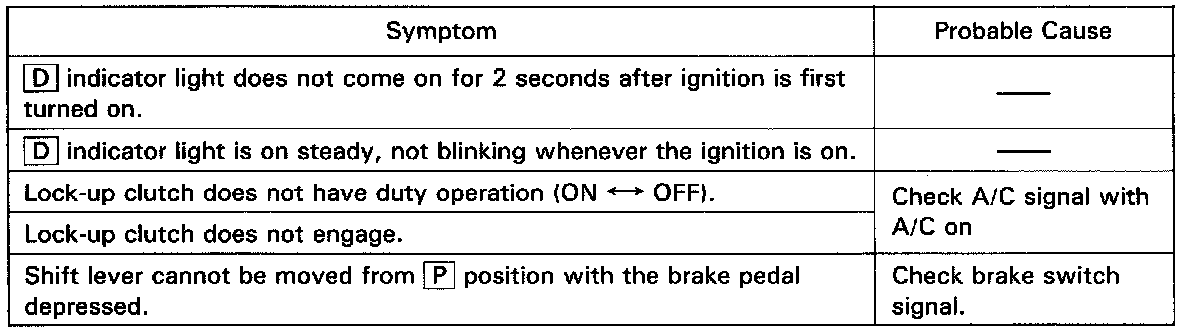
NOTE:
- If a customer describes the symptoms for codes 3, 6, 11, 14 or 15 yet the D indicator light is not blinking, it will be necessary to recreate the symptom by test driving, and then checking the D indicator light with the ignition still ON.
- If the D indicator light displays codes 1, 2, 3, 8, 11, or 16, check first the No. 9, 13 and 18 and fuse before electrical troubleshooting. If any of the fuses have blown, repair them and then recheck.
- If the "D" indicator light displays codes other than those listed above or stays lit continuously, the Transmission Control Module (TCM) is faulty.
- Sometimes the D indicator light and the Malfunction Indicator Lamp (MIL)/Check Engine light may come on simultaneously. If so, check the PGM-FI system according to the number of blinks on the MIL/Check Engine light, then reset the memory by removing the CLOCK fuse in the main relay box for more than 10 seconds. Drive the vehicle for several minutes at speed over 30 mph (50 km/h), then recheck the MIL/Check Engine light.
- PGM-FI system: the PGM-FI system on this model is a sequential multiport fuel injection system.
- The "D" indicator light may comes on, indicating a system problem, when, in fact, there is a poor or intermittent electrical connection. First, check the electrical connections, clean or repair connections if necessary.
- If the electrical readings are not as specified when using the test harness, check the test harness connections before proceeding.
- Disconnecting the CLOCK fuse also cancels the radio preset stations and the clock setting. Make note of the radio presets before removing the fuse so you can reset them.