Brake System, Bleeding
Brake System, Bleeding
=> [ Pre-Bleeding ]
=> [ Bleeding, Normal ]
=> [ Post-Bleeding ]
=> [ Brake Fluid, Changing Every 2 Years ]
Special tools, testers and auxiliary items required
• Brake filler/bleeder unit (VAS 5234)
• or
• Brake filler/bleeder unit (V.A.G 1869)
• Brake filler/bleeder unit suction adapter (V.A.G 1869/4)
• Vehicle Diagnosis, Testing and Information System (VAS 5051)
Commercially available tool:
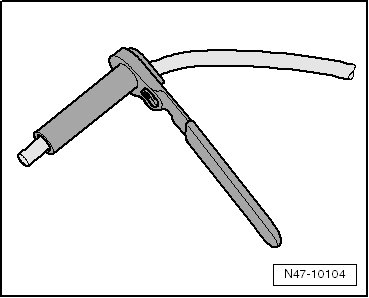
Description covers bleeding of brake system using the (VAS 5234) and (V.A.G 1869).
• Bleeding the braking system on vehicles with ABS is carried out as for vehicles with conventional braking systems.
• Only use new brake fluid conforming to US-Norm FMVSS 116 DOT 4.
• Genuine VW/Audi brake fluid conforms to this specification.
• Brake fluid is poisonous. Due to its caustic nature, it must also never be brought into contact with paint.
• Brake fluid is hygroscopic, meaning that it absorbs moisture from the surrounding air, and must therefore be stored in air-tight containers.
• Rinse off spills, by using plenty of water.
There must be a positive pressure of 2 bar to bleed the hydraulic unit.
• If one chamber of brake fluid reservoir has been run completely empty on vehicles with ABS/ASR or ABS/EDL/ASR/ESP (e.g. leaks in brake system), a pre-bleeding of the brake system must be performed first. Refer to => [ Pre-Bleeding ].
- Remove rear wheels.
Pre-Bleeding
Special tools, testers and auxiliary items required
• Brake filler/bleeder unit (VAS 5234)
• or
• Brake filler/bleeder unit (V.A.G 1869)
• Brake filler/bleeder unit suction adapter (V.A.G 1869/4)
• Vehicle Diagnosis, Testing and Information System (VAS 5051)
- Connect (VAS 5234) or (V.A.G 1869).
Bleeding sequence:
1 - Bleed left front and right front brake caliper together simultaneously.
2 - Bleed left rear and right rear brake caliper together simultaneously.
- With bleeder bottle hoses attached, leave bleeder valves open long enough that brake fluid exits without bubbles.
Then hydraulic unit must be bled once more via function "Basic setting" using -> Vehicle diagnostic tester.
Initiate basic setting (to bleed brake system):
- (VAS 5051), connecting and selecting functions, refer to => [ VAS 5051, Connecting and Selecting Functions ] Testing and Inspection.
- Then, brake system must be bled normally. Refer to => [ Bleeding, Normal ].
Bleeding, Normal
Special tools, testers and auxiliary items required
• Brake filler/bleeder unit (VAS 5234)
• or
• Brake filler/bleeder unit (V.A.G 1869)
Adhere strictly to work sequence when bleeding brake system.
- Connect (VAS 5234) or (V.A.G 1869).
- Open bleeder valves in the prescribed sequence and bleed brake caliper.
1- Front left brake caliper
2 - Front right brake caliper
3 - Left rear brake caliper
4 - Right rear brake caliper
Use suitable bleeder hose. It must fit tightly on bleeder valve so that no air can enter brake system.
- With bleeder bottle hose attached, leave bleeder valve open long enough that brake fluid exits without bubbles.
Post-Bleeding
A second mechanic is required to assist:
- Depress brake pedal forcefully and hold.
- Open bleeder valve at brake caliper.
- Press brake pedal down onto stop.
- Close bleeder screw with pedal depressed.
- Release brake pedal slowly.
This bleeding procedure must be performed 5 times per brake caliper.
Bleeding sequence:
1- Front left brake caliper
2 - Front right brake caliper
3 - Left rear brake caliper
4 - Right rear brake caliper
A road test must be performed after bleeding. During this, at least one ABS regulation must be performed!
- Install rear wheels.
Brake Fluid, Changing Every 2 Years
Maintenance, refer to => Brake and Clutch System; Brake Fluid, Changing.