Refrigerant Circuit, Servicing
Refrigerant Circuit, Servicing
• No refrigerant must be added into the refrigerant circuit (discharge, evacuate and recharge refrigerant circuit).
• Compressor is always driven when engine is running; there is no magnetic clutch. Engine is therefore not to be started unless refrigerant circuit has been properly assembled. For example; if the refrigerant lines are not connected to A/C compressor, when the engine is running the A/C compressor may heat up (via internal heat generation) so much that the A/C compressor will be damaged. Such internal heat generation results from the fact that - even with delivery near 0% - the compressor is confronted with a fixed resistance (sealed circuit).
• To stop the A/C compressor from being destroyed when the refrigerant circuit is empty, it is designed such that delivery is reduced to roughly 0% and lubrication is maintained by way of an internal oil circuit with the oil left in the A/C compressor.
• Replacement compressors contain the full quantity of refrigerant oil required for the refrigerant circuit.
• Coat the O-ring with refrigerant oil before installing. Refer to => [ Refrigerant Circuit O-Rings ] Refrigerant Circuit O-Rings.
• The specified diameters for O-rings seals and the tightening torques pertain also to the threaded connections of the refrigerant lines or hoses between the separate components.
• Only install O-rings that are approved for use with refrigerant R134a.
• A/C system cooling performance checking, refer to => [ A/C Unit, Checking Cooling Output ] A/C Unit, Checking Cooling Output.
• Check pressures in refrigerant circuit.
HD = High-pressure end
ND = Low-pressure end
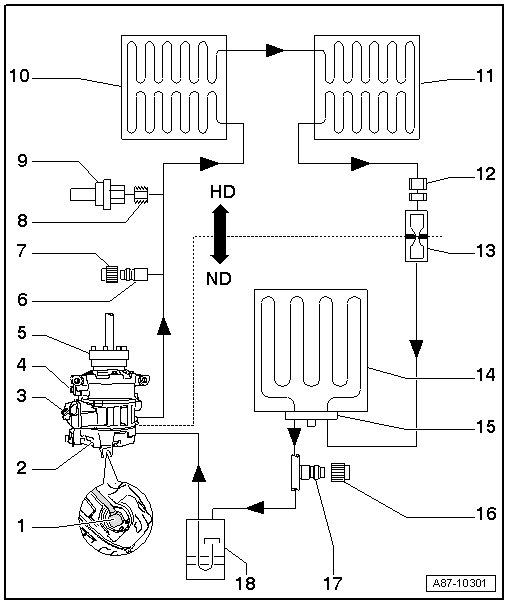
1 A/C Compressor Regulator Valve (N280)
• For checking activation and functionality, refer to => [ A/C Compressor Regulator Valve, Checking Switch-On Signal ] A/C Compressor Regulator Valve, Checking Switch-on Signal.
• The A/C compressor regulator valve is activated by the Climatronic Control Module (J255). It controls the pressure on the low pressure side of the refrigerant circuit.
2 A/C Compressor
• Different versions.
• Refrigerant Line, V8 engine, disconnecting from compressor and connecting, refer to => [ Refrigerant Lines, Disconnecting from Compressor and Connecting ] Refrigerant Circuit. V10 engine, refer to => [ Refrigerant Lines, Disconnecting from Compressor and Connecting ] Refrigerant Circuit.
• V8 engine, removing and installing, refer to => [ Compressor ] Compressors. V10 engine, refer to => [ Compressor ] Compressors.
3 Pressure Relief Valve
• Do not remove.
• Tightening specification 10 Nm.
4 Oil Drain Plug
• Tightening specification 30 Nm.
• the Denso A/C compressor has a seal installed.
• Should only be unscrewed to drain refrigerant oil and with the A/C compressor removed. To drain the refrigerant oil more quickly, turn the A/C compressor using the drive unit.
5 A/C Compressor Drive Unit
• Different versions.
• Checking and replacing, refer to => [ A/C Compressor Drive Unit ] Description and Operation.
• An overload safeguard is installed between the drive unit and A/C compressor driveshaft to protect the engine chain drive if the A/C compressor seizes up or does not move freely.
• If the A/C compressor is runs with resistance, the overload safeguard interrupts the supply of power to it.
• Rubber elements are installed between the A/C compressor drive unit and driveshaft. These rubber elements reduce vibrations that can result from running the A/C compressor (damper function if there are torque fluctuations).
6 High Pressure Side Service Connection
• Different versions (with primary sealing valve or with Schrader valve) depending on refrigerant line, distinguishing characteristics.
• To remove and install the service connection or the valve insert with the refrigerant circuit empty, use, for example, an adapter from the Socket for A/C Valves (T10364).
CAUTION!
Only remove service connections when the refrigerant circuit is empty. The connection does not have a valve.
• In order to make the service connections accessible, the left service flap (for the A/C system) in the Audi R8 Spyder must be removed from the engine compartment trim of the compartment cover.
7 Sealing Cap
• With seal.
• Always to be screwed on.
8 Connection With Valve
• With the refrigerant circuit empty, use an adapter from the Socket for A/C Valves (T10364) to remove and install a valve insert.
CAUTION!
The valve insert may be removed only when the refrigerant circuit is empty.
9 A/C Pressure/Temperature Sensor (G395)
• Housing color: gray.
• Removing and installing, refer to => [ A/C Pressure/Temperature Sensor ] Service and Repair.
• Checking the signal, refer to vehicle diagnosis, testing and information system VAS 5051/ in the "Guided Fault Finding" function.
• The A/C pressure/temperature sensor exchanges information with the Climatronic Control Module (J255) via the LIN Bus A/C databus system. A High Pressure Sensor (G65) cannot be installed on the Audi R8 (it only delivers square-wave signals).
• The temperature measured by the A/C pressure/temperature sensor differs from the actual refrigerant temperature in the refrigerant circuit because of the A/C pressure/temperature sensor design and its component location. Because of this, it is not currently evaluated and is not used to regulate the A/C system.
10 Condenser 1
• Left side of vehicle.
• Refrigerant lines, disconnecting and reconnecting, refer to => [ Refrigerant Lines, Disconnecting from Condenser and Connecting ] Refrigerant Circuit.
• Removing and installing, refer to => [ Condensers, Left and Right ] Refrigerant Circuit.
11 Condenser 2
• Right side of vehicle.
• Refrigerant lines, disconnecting and reconnecting, refer to => [ Refrigerant Lines, Disconnecting from Condenser and Connecting ] Refrigerant Circuit.
• Removing and installing, refer to => [ Condensers, Left and Right ] Refrigerant Circuit.
12 Union in Refrigerant Pipe (With Restrictor)
• Replace the O-ring seal.
• Tightening specification 15 Nm.
• The threaded connection may only be open when refrigerant circuit is empty; bring vehicle to a workshop that has the necessary tools and in which the work can be performed accordingly by qualified personnel.
13 Restrictor
• Installed in the threaded connection - item 12 -.
• O-ring seal: 7.5 mm/1.5 mm.
• Replace the restrictor with the O-ring seal.
• Removing and installing, refer to => [ Restrictor ] Refrigerant Circuit.
• Coat the O-ring seal lightly with refrigerant oil before installing.
14 Evaporator
• Replace the O-ring seals.
• Removing and installing, refer to => [ Evaporator ] Refrigerant Circuit.
• Refrigerant Line to A/C Unit, removing and installing, refer to => [ A/C Unit and Refrigerant Lines ] Refrigerant Circuit.
15 Refrigerant Line Threaded Connection (On The Evaporator)
• Threaded Connection, disassembling and assembling, refer to => [ A/C Unit and Refrigerant Lines ] Refrigerant Circuit.
• Hex socket bolt tightening specification: 25 Nm.
• The connection can only be removed when the refrigerant circuit is empty. Transfer the vehicle to a workshop that has the necessary tools and qualified personnel to perform the work.
16 Sealing Cap
• With seal.
• Always to be screwed on.
17 Low Pressure Side Service Connection
• Different versions (with primary sealing valve or with Schrader valve) depending on refrigerant line, distinguishing characteristics.
• To remove and install the service connection or the valve insert with the refrigerant circuit empty, use, for example, an adapter from the Socket for A/C Valves (T10364).
CAUTION!
Only remove service connections when the refrigerant circuit is empty. The connection does not have a valve.
• In order to make the service connections accessible, the left service flap (for the A/C system) in the Audi R8 Spyder must be removed from the engine compartment trim of the compartment cover.
18 Reservoir
• Replacing the O-ring seals.
• Coat the O-ring seals lightly with refrigerant oil before installing.
• Removing and installing, refer to => [ Reservoir ] Refrigerant Circuit.